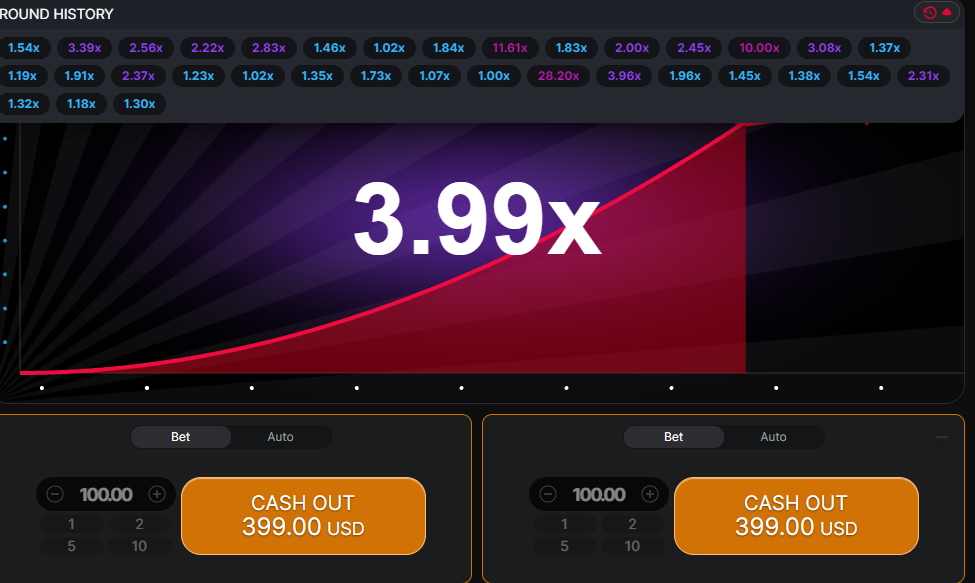
The multiplier is the most important number in Aviator. It starts at 1.00x when the plane takes off and climbs while the plane is in the air. The moment you press “Cash Out,” that number is applied to your stake and becomes your payout. If the plane flies away first, the stake is lost.
The core trade-off is simple: a higher multiplier means a higher potential return, but it also means more time exposed to the round ending.
This guide explains how to read multipliers, not how to predict them. You’ll learn what the numbers mean, how to calculate payouts, what different multiplier “patterns” look like, why those patterns don’t forecast anything, and how cryptography is used to prove the results weren’t manipulated.
New to the game? Start with The Complete Guide to the Aviator Game and Aviator Game Rules Explained Simply.
What Is an Aviator Multiplier?
When the plane rising , the multiplier is seen increasing in value, beginning at 1.00x. It represents the total return multiple on a successful cash-out, not just the profit.
Example: You stake $10 and cash out at 2.00x. You receive $20 in total: your original $10 back plus $10 profit.
If the plane flies away before you cash out, the multiplier no longer matters. The stake for that round is lost.
How the Multiplier Rises
Each round begins at 1.00x and increases in real time as the plane climbs. The climb can look fast or slow, but the animation doesn’t carry information. What matters is that the round ends at a random point.
Two facts are worth understanding:
- The crash point is determined before the round starts. The on-screen climb is a display of a result that already exists. Watching how fast the number moves tells you nothing about when it stops.
- Some rounds end immediately. A round can crash at 1.00x, leaving no chance to cash out. In theory these instant crashes happen roughly as often as the game’s house edge, around 3% of rounds with a 97% RTP.
How to Calculate Your Payout
The formula is:
Payout = Stake × Cash-out multiplier
And to find your profit:
Profit = Payout − Stake
Using a $10 stake:
- At 1.50x: payout is $15, profit is $5.
- At 2.00x: payout is $20, profit is $10.
- At 5.00x: payout is $50, profit is $40.
Multiplier Examples Table
| Cash-out multiplier | $10 stake payout | Profit if cashed out | Approx. chance of reaching it* |
|---|---|---|---|
| 1.20x | $12 | $2 | ~81% |
| 1.50x | $15 | $5 | ~65% |
| 2.00x | $20 | $10 | ~48.5% |
| 5.00x | $50 | $40 | ~19% |
| 10.00x | $100 | $90 | ~9.7% |
| 50.00x | $500 | $490 | ~1.9% |
*Theoretical approximations based on a 97% RTP (roughly 97% divided by the multiplier). They describe long-run averages, not any single session.
The table shows that the multiplier applies to your full stake and that the payout includes the original bet. It also shows why no target is “free money”: the better the payout, the lower the chance of getting it.
Low vs High Multipliers
| Type | Example | Potential benefit | Main risk |
|---|---|---|---|
| Low | 1.20x–2.00x | More frequent cash-outs, smaller swings | Smaller profit per win |
| Medium | 2.00x–5.00x | Larger potential return | Round must last longer |
| High | 10.00x+ | Very large potential return | Reached far less often |
A higher target pays more when it’s reached but is reached less often. Over the long run, each target returns about the same share of your stakes (around 97 cents per dollar). The difference between them is volatility: how bumpy the ride is. No multiplier target guarantees a profit.
How to Read the Multiplier During a Round
- 1.00x: The round has started, but no profit exists yet. Cashing out here returns only your stake.
- 2.00x: A cash-out now returns twice your stake. On $10, that’s $20.
- 10.00x: A cash-out now returns ten times your stake. On $10, that’s $100.
- After the plane flies away: The round ends, the result is added to the history strip, and any active bet that wasn’t cashed out is lost.
Visual timeline: Bet placed → 1.00x → multiplier rises → cash out or fly-away → next round.
[Image: multiplier timeline graphic.]
Do Multipliers Follow a Pattern?
This is where most beginners go wrong, so it deserves a clear answer: no. Previous multipliers do not predict the next one. Each round is independent.
The history strip at the top of the screen is a record of what happened, not a forecast. Still, if you watch long enough, the strip will look like it contains patterns. Below are the common shapes, with illustrative example sequences. These sequences are made-up examples for teaching, not real game data.
Pattern 1: The low cluster
1.12x · 1.34x · 1.08x · 1.61x · 1.19x · 1.45x
Six rounds in a row under 2x. It feels like a high one is “due.” It isn’t. At a 2x target, the chance of any given round ending below it is about 51.5%, so five in a row happens about 3.6% of the time. That sounds rare, but across hundreds of rounds, it’s expected.
Pattern 2: The spike
1.27x · 1.40x · 23.86x · 1.15x · 1.73x
One big multiplier amid small ones. Spikes are real, but they don’t follow low runs by rule. A 20x-plus round occurs roughly 5% of the time, so over 100 rounds you’d expect a handful, scattered with no schedule.
Pattern 3: The alternating run
1.45x · 3.12x · 1.20x · 2.65x · 1.31x · 2.98x
Low, high, low, high. It looks rhythmic, and players often bet on it continuing. It rarely does, and when it does, that’s luck.
Pattern 4: The instant crash
2.31x · 1.00x · 1.89x · 1.00x · 4.17x
Two 1.00x results close together look alarming, but at about 3% per round, they sometimes cluster. Nothing is “broken.”
Pattern 5: The hot streak
2.14x · 3.40x · 2.77x · 5.02x · 2.31x
Five rounds above 2x. It looks like momentum and tempts players to raise stakes. At a 48.5% chance each, five in a row is about 2.7%, uncommon but certainly possible. The next round is still a fresh draw.
What these patterns teach
Randomness is clumpy. Real random sequences contain streaks, clusters and runs that look meaningful. Humans are wired to see patterns, which is why “due” thinking feels so convincing. A coin that lands heads five times in a row is still 50/50 on the sixth flip, and Aviator works the same way. Predictor apps built on “reading patterns” cannot know the next outcome.
The Cryptography Behind Aviator Multipliers
If results are random, how do you know the operator didn’t just pick a crash point after seeing your bet? This is where cryptographic technology comes in.
What is cryptography?
Cryptography is the mathematics of securing information. In Aviator, the key tool is a cryptographic hash function such as SHA-256 or SHA-512. A hash function takes any input and produces a fixed-length string of characters, called a hash. It has three useful properties:
- Deterministic: The same input always gives the same hash.
- One-way: You can’t work backward from the hash to the input.
- Sensitive: Changing a single character in the input produces a completely different hash.
How it’s used in Aviator
Aviator uses a “provably fair” design. Spribe’s public documentation describes the general flow, which works like this (exact details can differ by version, so check the current documentation):
- Server seed. The game’s server generates a secret random value.
- Client seeds. Players’ devices contribute their own random values. Aviator’s description commonly refers to the first few bettors in a round.
- Combination and hashing. The server seed and client seeds are combined and run through a hash function. The output is a long string of characters.
- Conversion to a multiplier. A formula turns part of the hash into the round’s crash multiplier, including the house edge built into the game’s RTP.
- Verification. After the round, the seeds and hash are shown in the game’s fairness section. You can repeat the calculation with an independent tool and confirm it produces the same multiplier.
Since players contribute to the input, the operator can’t fully control the outcome. Because the hash is deterministic, anyone can recompute it afterward. Note that a hash is one-way and sensitive, as such nobody can tweak the seeds after the fact without producing a different result.
Cryptography vs a random number generator
A random number generator (RNG) produces unpredictable numbers. Cryptography adds verifiability: a way for you to check afterward that the number wasn’t altered. Many reputable games also undergo testing by independent laboratories, though the game’s own fairness data is the part you can check yourself.
What provably fair does not do
- It doesn’t make the game favour you. The house edge is built into the multiplier formula.
- It doesn’t predict future rounds.
- It doesn’t protect you from fake clones or unlicensed sites. Always confirm you’re playing the genuine game at a licensed operator.
For more depth, see Aviator Game RNG Explained and What Is Provably Fair Technology in Aviator? [internal links]
Auto Cash Out and Multipliers
Auto Cash Out lets you set a target multiplier before the round starts. The game tries to cash out automatically when the plane reaches that number.
Example: You stake $10 with Auto Cash Out at 1.70x. If the plane reaches 1.70x, you receive $17 (profit $7).
Remember that Auto Cash Out doesn’t protect you from a round that ends below your target. If the plane flies away at 1.55x, your 1.70x target never triggers and you lose the stake. It also depends on timing and connection quality, so network lag can occasionally affect execution.
Common Multiplier Misunderstandings
- “A 2x multiplier doubles my profit.” It doubles the total return. At 2.00x, your profit equals your stake.
- “High multipliers appear after low ones.” No. Rounds are independent.
- “The plane’s speed tells me when it will fly away.” No. The crash point is determined before the round begins.
- “Waiting longer is always better.” Waiting increases the potential payout and increases the chance of losing the stake.
- “A predictor can tell me the next multiplier.” No reliable predictor exists. Many are scams.
- “Provably fair means I’ll win more.” It only means the result can be verified as unaltered.
FAQs
What does 1.00x mean in Aviator?
It’s the starting multiplier. A cash-out at 1.00x would return only your original stake, with no profit.
What does 2x mean?
A successful cash-out returns twice your stake, including the original bet. On $10, you’d receive $20.
Can I cash out at any multiplier?
Yes, as long as the plane is still in the air and your bet is active.
Why did I lose at 1.00x?
Some rounds end immediately, before a cash-out is possible. They occur in a small share of rounds by design.
Is there a best multiplier to target?
No universal best target exists. Your choice affects volatility, not long-term results.
Can I verify a round myself?
Yes. The game’s fairness section shows the data for past rounds, which you can check with a hash calculator or the operator’s verification tool.
Are the patterns in the history strip useful?
They’re interesting to look at but not useful for predicting the next round.
Conclusion
Your payout is determined by the multiplier and your stake: Payout = Stake × Cash-out multiplier. A higher multiplier pays more but is reached less often, and no target guarantees profit. The patterns you see in the history strip are the normal clumpiness of random numbers, not signals. Meanwhile, cryptographic hashing, seeds and verification are what let you check that each round’s result wasn’t changed after the fact.
Play only on licensed platforms, practise in demo mode, use small stakes and stop when your limits say so.
Keep reading: