If you are new to Aviator, you have probably seen claims of a “winning formula” or a “secret trick” that beats the game. Here is the honest truth: every Aviator round is random, and no strategy can predict when the plane will fly away. What a good strategy can do is help you manage risk: how much you stake, when you cash out, and when you stop.
This guide gives you a simple, beginner-friendly framework built on bankroll control, consistent stakes, sensible cash-out targets, and firm session limits. Later, it also explains two popular player techniques, the High Multiplier technique and the After Purple technique, along with the discipline and bankroll rules that make them safer to try.
Play only with entertainment money, and never chase losses.
What an Aviator Strategy Can and Cannot Do
Before you pick a method, it helps to know what any strategy is realistically able to do.
| A strategy can help you | A strategy cannot do |
|---|---|
| Control how much you risk per round | Predict the next multiplier |
| Make sessions more consistent | Remove the house edge |
| Reduce emotional decisions | Guarantee a profit |
| Help you survive losing streaks | Turn past results into future predictions |
| Make it easier to stop on time | Guarantee that a chosen multiplier is reached |
| Win stratetigically | Predict when a big multiplier or purple streak will occur |
Aviator is commonly listed with an RTP (return to player) of about 97%. That means that over a very large number of rounds, the expected return is roughly 97 cents per dollar wagered, whatever cash-out target you choose. The remaining 3% is the house edge.
So what do strategies actually change? Mainly volatility: how often you win and how large your swings are. A low cash-out target gives frequent small wins. A high one gives rare big wins and long dry spells. Neither changes the long-run math.
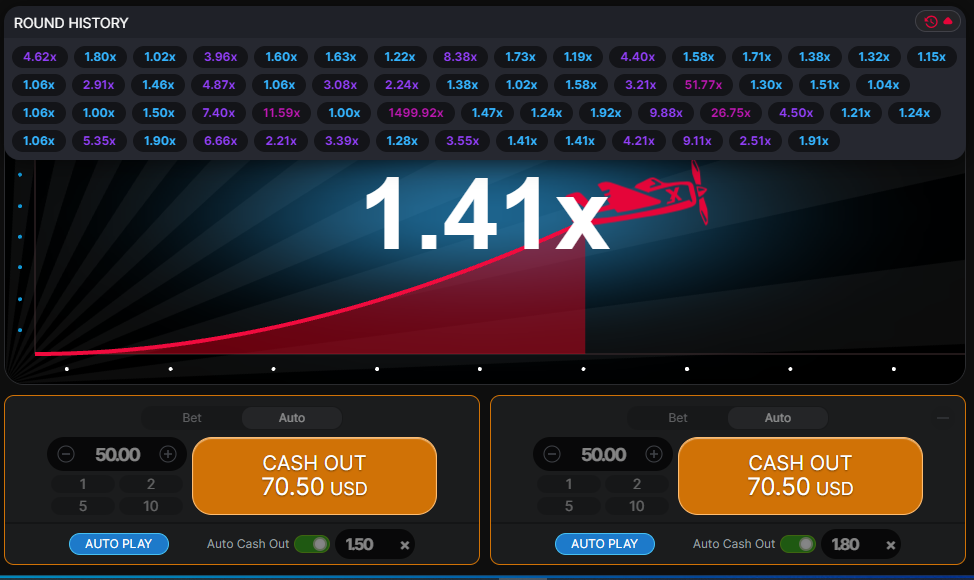
Step 1: Start With a Session Bankroll
Your session bankroll is the fixed amount you set aside for one playing session.
- Keep it separate from money you need for rent, food, school fees, transport, or bills.
- Decide the amount before you open the game, not after losses begin.
- Treat it as the maximum you will play with, no matter what happens.
Example: If your session budget is $100, that is the most you have available for that session. When the $100 is gone, the session is over. No reloading, no borrowing, no “one more try.”
Step 2: Use Flat Betting
Flat betting means staking the same amount every round. You do not raise your stake after a loss, and you do not get carried away after a win.
Why it works for beginners:
- It makes your results easy to track.
- It prevents emotional stake increases.
- It gives your bankroll room to survive normal losing streaks.
A sensible starting point is 1–2% of your session bankroll per round.
- Session bankroll: $100
- 1% stake: $1
- 2% stake: $2
If you are unsure, choose the smaller number. A smaller stake keeps you playing longer and keeps your decisions calmer.
Step 3: Choose a Beginner Cash-Out Target
Your cash-out target decides how long each bet stays in the air, and therefore how volatile the session feels.
| Target | Risk level | What to expect |
|---|---|---|
| 1.20x–1.50x | Lower | Smaller, more frequent successful cash-outs |
| 1.50x–2.00x | Moderate | A balance between frequency and payout size |
| 3.00x–5.00x+ | Higher | Larger potential payouts, but more frequent losses |
For beginners, a range of 1.20x to 2.00x is a reasonable place to start. Many new players settle around 1.50x because it balances smaller, more frequent cash-outs with manageable swings.
Keep in mind that no target is guaranteed. Even a 1.20x target fails whenever the round ends before 1.20x. Beginners should also avoid high-multiplier “moonshot” play until they understand bankroll risk (the High Multiplier section below explains how to approach it carefully).
Step 4: Use Auto Cash Out
Auto Cash Out automatically closes your bet when the multiplier reaches the number you chose.
Why it helps beginners:
- It removes reaction-time pressure.
- It reduces impulsive “just a little longer” decisions.
- It keeps you consistent with your plan.
Example: You stake $1 and set Auto Cash Out at 1.50x. If the multiplier reaches 1.50x, the game attempts to cash out for you automatically, returning $1.50.
Two important clarifications. First, Auto Cash Out does not protect you if the round ends below your target. Second, it does not change the odds. It is a discipline tool, not an advantage. If your version of the game has a demo mode, test the setting there first.
Step 5: Set a Loss Limit
A loss limit is the maximum you are willing to lose before ending the session. A common approach is to stop after losing 10–20% of the session bankroll.
- Session bankroll: $100
- 15% loss limit: $15
- If your balance falls to $85, you stop.
This protects you from the most damaging mistake in any crash game: trying to win back losses with bigger bets. Once you hit the limit, close the game and walk away. Come back another day with a fresh, planned session budget.
Step 6: Set a Win Limit
A win limit is a modest profit target at which you stop, or at least protect your profit. It prevents you from giving back an early gain during a later losing streak.
For beginners, a 5% target per session is a sensible discipline goal:
- Session bankroll: $100
- Win target: $105 (a $5 profit)
- When your balance reaches $105, stop. Alternatively, withdraw the original $100 and continue only with the profit.
Smaller targets are easier to hit and harder to give back. A win limit is a personal discipline tool, not a prediction of future results. Some sessions will never reach it, and that is normal.
A Simple Beginner Strategy Example
Here is a complete plan you can follow, adjusted to your own budget:
- Session bankroll: $100
- Stake per round: $1 (1% of the bankroll)
- Cash-out target: 1.50x
- Auto Cash Out: On
- Loss limit: $15 (stop at $85)
- Win limit: $105 (5% profit)
- Session length: Stop after 30–50 rounds, or when either limit is reached
How to run it:
- Decide your bankroll, stake, and limits before you start.
- Set your stake and Auto Cash Out.
- Play your rounds without changing the stake.
- Stop when you hit the loss limit, the win limit, or the round count, whichever comes first.
- Write down the result.
This plan does not guarantee winnings. What it gives you is clear rules and a cap on the damage from a bad session.
Advanced Technique 1: The High Multiplier Strategy (10x–100x+)
18+ only. Gambling involves risk. No strategy guarantees profit. Only play with money you can afford to lose.
Note for beginners: master flat betting and session limits first. This technique is high-volatility and suits only money you can fully afford to lose.
What it is
The High Multiplier technique is a low-stake approach aimed at catching rare, large multipliers, from 10x up to 100x or more. These rounds happen far less often than small ones, so most of your rounds will lose. The idea is that one successful cash-out at 10x or higher repays many small losing stakes.
The waiting-period routine
Many players use round history timestamps to build a simple timing routine. The idea works like this:
- Note the time of each 10x+ round in the history.
- Calculate the gap between one big multiplier and the next.
- Add that gap to the time of the latest big multiplier, and start betting around that mark.
Example: Two 10x+ rounds landed 4 minutes apart. When the next one appears, the player waits about 4 minutes and then begins placing small bets around that point, hoping to catch another 10x+ round.
Players who use this method say it sometimes seems to line up, and results in good profits. However this may miss sometimes. That matches how the game works: each round is generated independently, so the time since the last big multiplier does not make the next one more likely. A gap pattern that appears to “work” is usually a probability. The honest way to treat this routine is as a patience and pacing tool: it stops you from betting every single round out of boredom and gives you a structured reason to wait. It is not a signal, and it is not a prediction.
Bankroll rules for the High Multiplier technique
Because this approach loses most rounds, bankroll rules matter more here than anywhere else:
- Stake only 0.5–1% of your session bankroll per round (for example, $0.50–$1 on a $100 bankroll).
- Use Auto Cash Out at a fixed target (for example, 10x) so you are not reacting emotionally.
- Expect long losing streaks. Budget for 50–100 losing rounds. If you cannot comfortably absorb that, lower your stake.
- Set a hard loss limit of 10–15% and stop when you hit it.
- Never raise stakes to “catch up” because a big multiplier feels overdue. It is never “due.”
- Never use Martingale with this technique. The losing streaks are far too long.
Warning: High volatility means a bankroll can drain quickly, even with small stakes. A session with zero big multipliers is completely normal.
Discipline checklist
- Do not bet through the whole waiting period out of boredom.
- Do not abandon your plan after a miss.
- Do not increase your stake after a long dry spell.
- Log every session: start time, gaps tracked, stake, rounds played, and result. Over time, your own log will show you what is actually happening, which is usually more sobering and more useful than any rumor.
Advanced Technique 2: The After Purple Strategy (2x–4x)
18+ only. Gambling involves risk. No strategy guarantees profit. Only play with money you can afford to lose.
What it is
In most Aviator interfaces, round results are color-coded: blue for low multipliers (roughly 1.00x–1.99x), purple for 2x and above, and pink for much higher results (often 10x+). The After Purple technique works like this: the player waits for a purple (2x or higher) round, then places a bet in the round right after it, targeting a 2x–4x cash-out.
When to play
Players who use this method follow a simple history filter:
- Play when the recent history shows more purples and pinks.
- Avoid sessions where the history shows mostly blues, or results between 1.00x and 1.99x.
This is a visual, recent-history filter. It can feel useful, but it does not change the odds of the next round, and the house edge still applies. Think of it as a way to stay selective and avoid constant betting, not as a way to see the future.
How to play it
- Watch the history and wait for a 2x+ result.
- Place a bet in the following round (some players also include the next one or two rounds).
- Set Auto Cash Out between 2x and 4x. Beginners should start at 2x.
- If the history turns blue-heavy, stop betting and wait.
- Stop as soon as you reach your session profit target.
Staking methods
Flat betting (recommended). Use the same stake every round, for example $1 on a $100 bankroll. It is simple, predictable, and keeps losses under control.
Martingale (optional, high risk). Some players increase their stake after a loss to recover earlier losses with one win. It looks attractive on paper, but here is the problem:
| Round | Stake | Total spent after a loss |
|---|---|---|
| 1 | $1 | $1 |
| 2 | $2 | $3 |
| 3 | $4 | $7 |
| 4 | $8 | $15 |
| 5 | $16 | $31 |
The required bet grows exponentially. Four losses in a row on a $1 base stake already costs $15, which is your entire 15% loss limit on a $100 bankroll. A short losing streak can wipe out a session, and table bet limits can block recovery altogether. If you choose to use Martingale, cap the progression at two or three steps and never let it push you past your loss limit.
Bankroll, patience, and discipline rules
- Target only 5% profit per session ($5 on a $100 bankroll). When you reach it, stop.
- Stake low: 1% or less of the session bankroll.
- Set a 10–15% loss limit and obey it.
- Patience: skipping rounds is part of the strategy. Waiting for the right history conditions is the discipline.
- Do not chase after a losing streak, and do not play while frustrated, tired, or upset.
- Keep expectations honest: this technique does not always work. Small, consistent gains are possible in some sessions, but losing sessions are normal. Flat staking and a small target are what make the swings manageable.
Should Beginners Use Two Bets?
Some Aviator versions let you place two independent bets in the same round. A two-bet setup can create different risk profiles, but it also increases your total exposure.
Beginner example:
- Bet 1: $1 with Auto Cash Out at 1.30x
- Bet 2: $1 with a higher manual target
Remember that both bets can lose if the plane flies away early. Absolute beginners should start with one bet and try two-bet setups only after they are comfortable with limits and flat staking.
Beginner Mistakes to Avoid
- Increasing stakes after losses to “win it back.”
- Using Martingale or other progression systems without a stake cap, or without understanding the risk.
- Believing a big multiplier is “due.”
- Chasing high multipliers after seeing them in the round history.
- Ignoring stop-loss and stop-win limits.
- Betting more than 1–2% of the session bankroll per round.
- Trusting predictors, hacks, apps, or social-media “signals.” Aviator cannot be predicted, and many of these are scams.
- Playing while upset, tired, or under financial pressure.
Frequently Asked Questions
What is the best Aviator strategy for beginners?
A simple flat-betting plan with a low cash-out target, Auto Cash Out enabled, and clear loss and win limits is usually the most manageable starting point.
What cash-out multiplier should beginners use?
Many beginners start around 1.50x because it balances smaller, more frequent cash-outs with manageable volatility.
Does a strategy guarantee winnings?
No. Every strategy can only manage risk and volatility. It cannot remove the house edge or guarantee a profit.
Should I increase my bet after a loss?
No. Increasing stakes after losses is a common way to lose a bankroll quickly.
Is Auto Cash Out a good beginner tool?
Yes, as a discipline tool. It does not change the odds, but it can reduce emotional cash-out decisions.
Can you predict when a 10x multiplier will appear?
No. Tracking time gaps between big multipliers is a routine for staying patient, not a prediction method. Each round is independent.
What is the After Purple strategy?
It is a method where the player waits for a 2x+ round, then bets in the following round targeting 2x–4x, and only plays when the recent history shows more purples and pinks. It does not change the odds of any round.
Is Martingale safe in Aviator?
No. Martingale can lose a bankroll fast because stakes grow exponentially. If you use it at all, cap it at two or three steps and stay inside your loss limit.
Conclusion
The best Aviator strategy for beginners is not a secret formula. It is a framework: a fixed session bankroll, a flat stake, a conservative cash-out target, Auto Cash Out, and firm loss and win limits. Once you are comfortable with that, you can experiment with the High Multiplier and After Purple techniques, as long as you keep stakes low, targets small, and your discipline intact.
The purpose of strategy is controlled play, not guaranteed profit. If you ever feel the urge to chase losses, bet money you need for essentials, or keep playing after hitting your limit, stop and take a break. If gambling stops being fun, support services are available in your country.
Keep reading:
- Aviator Game Bankroll Management Tips
- How to Win in Aviator Game: Realistic Expectations
- Best Aviator Game Betting Strategies Compared
- Aviator Game Cash Out Strategy
18+ only. Gambling involves risk. No strategy guarantees profit. Only play with money you can afford to lose.