Introduction
18+ only. Aviator is a gambling game. Outcomes are random and not all strategies guarantees a win. Only play with money you can afford to lose.
Aviator is a fast-paced crash game built around one decision: when do you cash out? A plane takes off, a multiplier climbs from 1.00x, and you must press “Cash Out” before the plane flies away. Cash out in time and you collect your stake multiplied by the current number. Miss it and the stake for that round is gone.
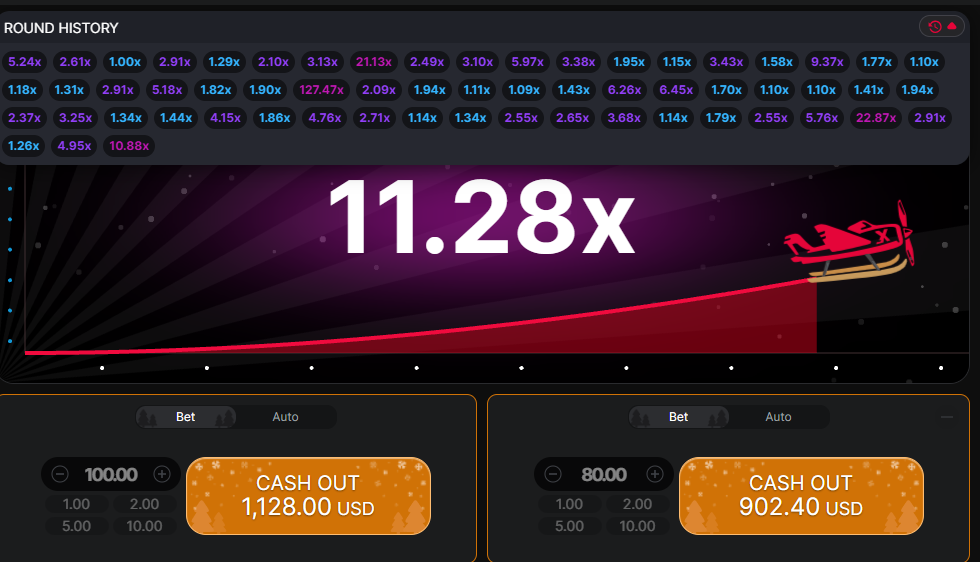
Its popularity comes down to a few things:
- Short rounds. A round usually takes seconds to a little over a minute.
- Simple controls. There are no reels, paylines or complicated rules.
- Mobile-friendly design. It runs smoothly on a phone.
- Visible live results. You see other players’ bets and cash-outs in real time, which gives the game a social feel.
This guide covers how Aviator works, how a round plays out, what the terms mean, how multipliers and payouts are calculated, whether the game is fair, and how to play responsibly. One thing up front: Aviator is a game of chance. There is no reliable way to predict or beat it, and anyone who claims otherwise is selling something.
What Is the Aviator Game?
Aviator is a crash game, most closely associated with the studio Spribe, which released it in 2019. It’s a different kind of product from a traditional slot. A slot has reels, symbols and paylines. Aviator has a single rising multiplier and a single choice.
On screen, a small red plane takes off on a graph. As it climbs, the multiplier in the centre increases: 1.10x, 1.50x, 2.00x and onward. Your goal is to cash out before the plane flies away. The payout is locked at whatever multiplier showed when you pressed the button.
It’s called a “crash game” because the round can end suddenly at a point nobody knows in advance. Sometimes the plane leaves almost immediately at 1.01x. Sometimes it climbs past 10x, 50x or higher. The uncertainty is the whole appeal, and also the risk.
How an Aviator Round Works
Every round follows the same five steps.
- Betting window. Before takeoff, you have a short countdown to choose your stake and confirm your bet. Bets can’t be placed once the plane is in the air.
- Takeoff. The plane launches and the multiplier starts at 1.00x.
- The multiplier rises. The longer the plane stays up, the higher the potential payout becomes. The number can climb slowly or very quickly.
- Cash out. Press “Cash Out” while the plane is still flying. You receive your stake multiplied by the current multiplier.
- Fly-away. If the plane leaves before you cash out, the stake for that round is lost. Then the next betting window opens.
A simple example: You bet 1,000 USD. If you cash out at 2.00x, you receive 2,000 USD (your 1,000 back plus 1,000 profit). If the plane flies away at 1.80x before you press the button, you lose the 1,000 USD.
The speed is part of the draw. Rounds follow one another quickly, which is exactly why discipline matters. It’s easy to place many bets in a short time.
Key Aviator Terms Explained
Before you play, get comfortable with the vocabulary.
- Multiplier: The rising number that determines your payout if you cash out in time.
- Cash out: The action that locks in your winnings at the current multiplier.
- Crash point (or fly-away point): The random point where the round ends. Any bet not cashed out by then loses.
- Auto cash out: A preset multiplier (for example 2.00x) at which the game closes your bet for you, so you don’t have to click in time.
- Auto bet: A feature that repeats your chosen stake automatically across rounds. Use it with caution, since it can run up losses without you noticing.
- Double bet: The option to place two separate bets in the same round, each with its own stake and cash-out decision. Some players use one for a low, safer target and one for a higher, riskier target.
- Stake: The amount you wager on a round.
- RTP (Return to Player): The theoretical share of wagers returned to players over a very large number of rounds. Aviator’s published RTP is about 97%. It’s a long-term statistical figure, not a promise about any session.
How the Multiplier and Payout Work
The multiplier starts at 1.00x and rises with no predictable pattern. It can speed up, stall or end at any moment.
The payout formula is simple:
Payout = stake × cash-out multiplier
Here are some examples with a 1,000 MWK stake:
| Cash-out multiplier | Payout | Profit |
|---|---|---|
| 1.50x | 1,500 USD | 500 USD |
| 2.00x | 2,000 USD | 1,000 USD |
| 5.00x | 5,000 USD | 4,000 USD |
The risk and reward trade-off
Lower targets like 1.50x are reached more often, but the profit per win is small. Higher targets like 5.00x or 10.00x pay far more, but the plane reaches them far less frequently. There’s no free lunch: the higher your target, the greater the chance of losing the round.
This is why no cash-out point is “correct.” A cautious player cashing out early will win more rounds but win less each time. An aggressive player will lose more rounds but occasionally hit a big multiplier. Over the long run, the house edge applies to both.
Is Aviator Fair?
This is the question most beginners ask, and it deserves a straight answer.
Random outcomes
Reputable versions of Aviator use a random number generator (RNG), so each round’s outcome is randomised and independent. Previous rounds do not influence the next one.
Provably fair, in simple terms
Aviator uses a provably fair system. Roughly, it works like this: the crash point of each round is generated from a combination of inputs that include a server-side value and values contributed by players. After the round, you can check a cryptographic record to verify the result wasn’t altered. In practice, the game lets you inspect this through a round-history or fairness section, where you can see the data behind past rounds.
This verification confirms that rounds weren’t manipulated after the fact. It does not make you win. The house edge still exists, and any single session can end in a loss.
Past rounds do not predict the next one
A common myth is that after several low crashes, a big multiplier is “due.” It isn’t. Each round is independent, just like a coin that doesn’t “remember” its last flip. Streaks happen by chance, and they carry no predictive value.
If you want to dig deeper, see our related guides: Is the Aviator Game Rigged or Fair?, Aviator Game RNG Explained, and What Is Provably Fair Technology in Aviator? [internal links]
Where you play matters
The game itself can be fair while the platform you play on is not. Only play at licensed, reputable operators. Clone games and fake apps that imitate Aviator exist, and they may not use genuine software.
How to Start Playing Safely
If you decide to play, a few habits make a big difference.
Choose a licensed, reputable site. Look for a clear licence in the footer, verify it with the regulator, and avoid apps or links sent through social media. Check that the operator accepts players from your country and that you are of legal age.
Start in demo mode or with the smallest stake. Many operators offer a free demo with virtual money. Use it to learn the cash-out rhythm and the interface before risking real money.
Set a budget before you begin. Decide how much you can afford to lose, and stop when you reach it. Treat gambling money as an entertainment cost, like a cinema ticket, never as income or a way to fix financial problems.
Use responsible-gambling tools. Most licensed operators provide:
- Deposit limits
- Session time limits and reality checks
- Loss limits
- Self-exclusion options
Be careful with automation. Auto bet saves clicks, but it can burn through a balance quickly. Set limits and watch your session.
Avoid “hacks” and predictors. Telegram signal groups, prediction apps and “guaranteed” systems are widely reported scams. Because outcomes are random, none of them can reliably predict a crash. Many exist to steal deposits or personal data.
Take breaks and never chase losses. If you feel frustrated or tempted to bet more to win it back, stop for the day.
For more, read Responsible Gambling Tips for Aviator Players and Aviator Game Bankroll Management. [internal links]
Warning signs of problem gambling
Pay attention if you notice you are:
- Betting more than you planned
- Chasing losses
- Hiding your gambling from others
- Borrowing money to play
- Feeling anxious or irritable when you aren’t playing
If any of this sounds familiar, use your operator’s self-exclusion tools and contact a local support service or helpline.
Common Beginner Questions
Can you predict when the Aviator plane will fly away?
Yes if you know what you are doing. The outcome is random and each round is independent. Studying previous rounds may help you understand the game but doesn’t reveal what comes next.
What happens if I don’t cash out?
You lose the stake for that round. If the plane flies away before you press “Cash Out” (or before your auto cash-out target is reached), the bet is lost.
Does auto cash out improve my chances?
It can help with consistency and protect against missed clicks or slow connections, but it doesn’t change the game’s underlying odds. It’s a convenience and discipline tool, not a winning trick.
Is Aviator the same as a slot machine?
No. A slot uses reels and paylines. Aviator’s core mechanic is a rising multiplier and your cash-out timing. Both are games of chance with a house edge, but they play very differently.
Can I play Aviator on mobile?
Yes. The game is designed to work well on smartphones, usually through your operator’s mobile site or app. Always download apps from official sources.
Is Aviator really worth playing for money?
That’s a personal choice. Think of it as entertainment with a cost. The published RTP implies that, on average, players lose a small percentage of what they wager over time, and short-term results can swing widely in either direction.
Is Aviator legal where I live?
Online gambling laws vary widely between countries and even regions. Check your local rules and the operator’s list of accepted territories before depositing.
Conclusion and Next Steps
Aviator’s mechanic is easy to describe: place a bet, watch the multiplier rise, and cash out before the plane flies away. That simplicity is what makes it compelling, and also what makes it easy to overplay.
Remember the essentials:
- Payout = stake × the multiplier at which you cash out.
- Higher targets mean higher potential rewards and a greater chance of losing the round.
- Provably fair technology verifies that rounds weren’t tampered with, but it doesn’t remove the house edge.
- No strategy, signal or app can guarantee a win because every outcome is random.
- Play only with licensed operators, set a budget, and use responsible-gambling tools.
Keep learning: